From one line to a network
The first line linked Tokyo and Osaka. Now the Shinkansen reaches three of Japan’s main islands.
How this site works. Every fact is in our own words and linked to its source, beside it. Where good sources disagree, we show each version in a “Sources differ” box.
Shinkansen lines now run on the islands of Honshu, Kyushu and Hokkaido. Britannica
West to Kyushu
The line was extended west from Osaka to Okayama in 1972, and on to Hakata in Fukuoka in 1975. Britannica
Half of the Sanyo Shinkansen, from Osaka to Hakata, is in tunnels. JFS, 2005
Much of the track runs in tunnels, including one under the Shimonoseki Strait between Honshu and Kyushu. Britannica
On Kyushu, a line opened between Yatsushiro and Kagoshima in 2004 and the full route north to Hakata in 2011. Britannica
A branch to Nagasaki opened in 2022. Britannica
North to Aomori and Hokkaido
Lines north from Tokyo to Niigata (the Joetsu line) and Morioka (the Tohoku line) were finished in 1982. Britannica
The Tohoku Shinkansen opened in 1982 and runs from Tokyo to Shin-Aomori, the longest line JR East runs. JR East
The Tohoku line was extended north to Hachinohe in 2002. Britannica
When the line to Aomori opened in 2010, the Shinkansen ran almost the whole length of Honshu. Britannica
A tunnel near Aomori was a record 26.5km long for a double-track tunnel on land when it was finished in 2005. Britannica
A line from Aomori through the Seikan Tunnel to Hakodate, on Hokkaido, opened in 2016. Britannica
Work on the section from Hakodate to Sapporo began in 2012 and Britannica expects it to be finished in 2031. Britannica
Branches
Branch lines to Yamagata and Akita opened in 1992 and 1997, and a branch to Nagano in 1997. Britannica
The Nagano line was extended west to Toyama and Kanazawa in 2015. Britannica
How it runs
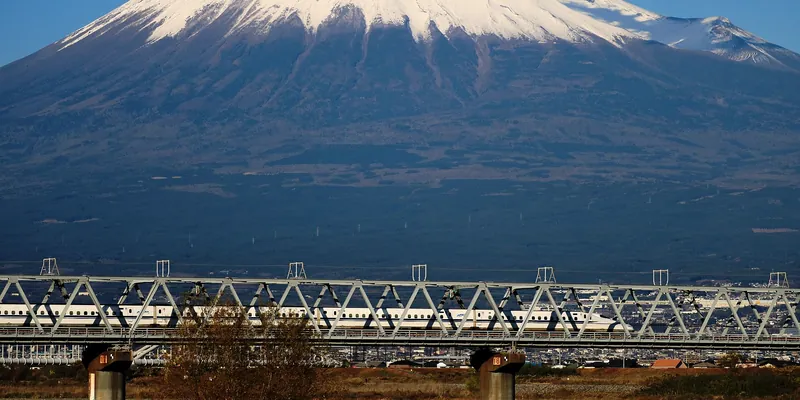
Several hundred trains run on the Shinkansen system every day. Britannica
The trains are electric multiple units, powered from overhead wires, and can seat 1,000 passengers or more. Britannica
Every train movement is monitored and controlled by a central computerised centre in Tokyo. Britannica
Next: the trains →