Floating at 603 km/h
JR Central’s superconducting maglev will be the next Shinkansen.
How this site works. Every fact is in our own words and linked to its source, beside it. Where good sources disagree, we show each version in a “Sources differ” box.
The record
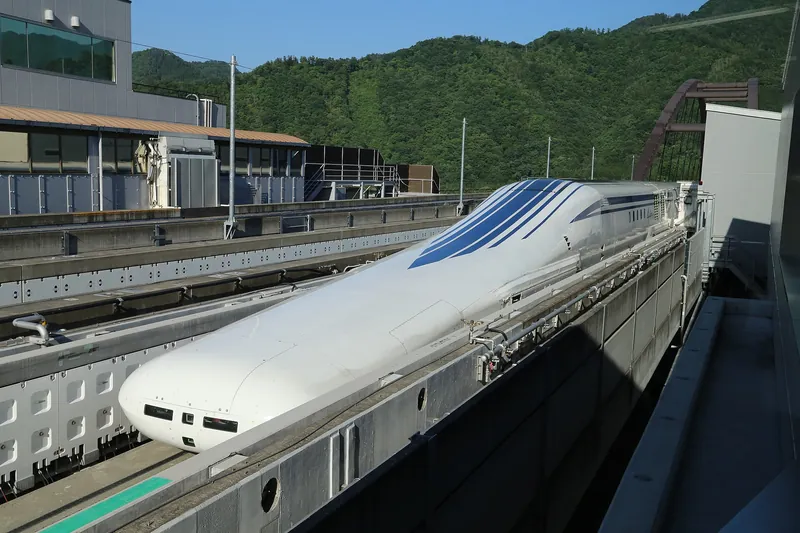
On 21 April 2015 a Series L0 maglev of JR Central reached 603km/h (374mph) on the Yamanashi Maglev Line, the fastest maglev train on record. Guinness
JR Central began building its L0 (‘L zero’) maglev trains in 2010. Guinness
In April 2015 a maglev also ran 4,064km in a single day, a record for the line. JR Central maglev
The Yamanashi Maglev Line is still a test line. Guinness
How it floats
The train is lifted about 10cm (3.9 inches) off the guideway by magnets on the train and coils in the track. JR Central maglev
At low speed it runs on rubber wheels, and above about 150km/h (93mph) it lifts off and tucks them away. JR Central maglev
Tests began on the first 18.4km of the Yamanashi line in April 1997; it was extended to 42.8km in August 2013. JR Central maglev
Since November 2014 about 80,000 people have ridden the test maglev at 500km/h. JR Central maglev
Britannica says the kingfisher idea was used to cure a tunnel ‘boom’ on Japan’s maglev trains. Britannica
The Chuo Shinkansen
The maglev line will be part of the Chuo Shinkansen, which JR Central says will link Tokyo and Nagoya in as little as 40 minutes and Tokyo and Osaka in 67 minutes. JR Central maglev
Chuo Shinkansen trains are planned to have 16 cars, like the Tokaido Shinkansen. JR Central maglev
The project missed its first target of 2027 after Shizuoka’s governor opposed a survey; Britannica now gives 2034 for Tokyo to Nagoya. Britannica
The extension to Osaka is planned for 2037, and the line is planned to run at 500km/h. Britannica
Next: myths →