The first new main line
Ten days before the Tokyo Olympics, Japan opened a railway unlike any before it.
How this site works. Every fact is in our own words and linked to its source, beside it. Where good sources disagree, we show each version in a “Sources differ” box.
1 October 1964
The Tokaido Shinkansen opened on 1 October 1964, just 10 days before the Tokyo 1964 Olympic Games began. Embassy of Japan
Many people saw it as a symbol of Japan’s modernisation after the war. Embassy of Japan
Shinkansen means ‘new main line’. Science Museum Group
It was the first railway route built just to move large numbers of people in comfort and at high speed. NRM The National Railway Museum says that with it, Japan reinvented passenger railways. NRM
The bullet train
The first trains, the Series 0, were the first in the world to run in passenger service at a top speed of 210km/h. Embassy of Japan
The first bullet trains ran at up to 130mph. NRM
They were soon called ‘bullet trains’, for their speed and for the bullet shape of their noses. Britannica
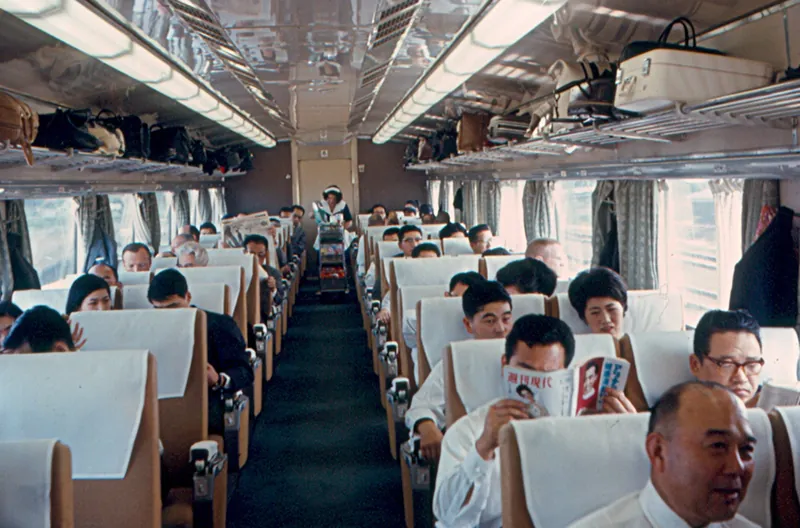
Tokyo to Osaka
The first section, between Tokyo and Osaka, was 515km (320 miles) long. Britannica
The line roughly follows, and is named after, the old Tokaido (‘Eastern Sea Road’) highway of the Edo period. Britannica
How long did it take at first? Sources differ
- At first the journey from Tokyo to Osaka took 4 hours, instead of 6 hours 30 minutes on an ordinary express. Embassy of Japan
- The first services were the 4-hour ‘Hikari’ and the 5-hour ‘Kodama’ between Tokyo and Shin-Osaka. MLIT Japan
- The Science Museum Group says the line was about 320 miles long and its trains took a little over three hours. Science Museum Group
- JR Central says the time came down to 3 hours 10 minutes, from 4 hours when the line opened. JR Central, 2024
The 4-hour figure is for the opening timetable in 1964; JR Central says the time later came down to 3 hours 10 minutes, which matches the Science Museum Group’s “a little over three hours”.
How it was built
Its builders introduced new ideas such as prestressed concrete sleepers and mile-long welded lengths of rail. Britannica
Unlike earlier Japanese trains, the Tokaido Shinkansen and every Shinkansen line since have been standard gauge. Science Museum Group
It was built and run by the state-owned Japanese National Railways, and has been part of the private Japan Railways Group since 1987. Britannica
Central Japan Railway Company, JR Central, was set up on 1 April 1987, when JNR was privatised and broken up. JR Central, 2024
Hideo Shima
The chief engineer was Hideo Shima, born in Osaka in 1901, who had joined the Ministry of Railways in 1925 to design steam locomotives. NRM
In 1955 Japanese National Railways asked Shima to oversee the Shinkansen project as chief engineer. NRM
Shima’s team designed the sleek cone-shaped front, inspired by the aircraft of the time. NRM
The bullet train also brought in air suspension and air conditioning. NRM
A bullet train in Britain
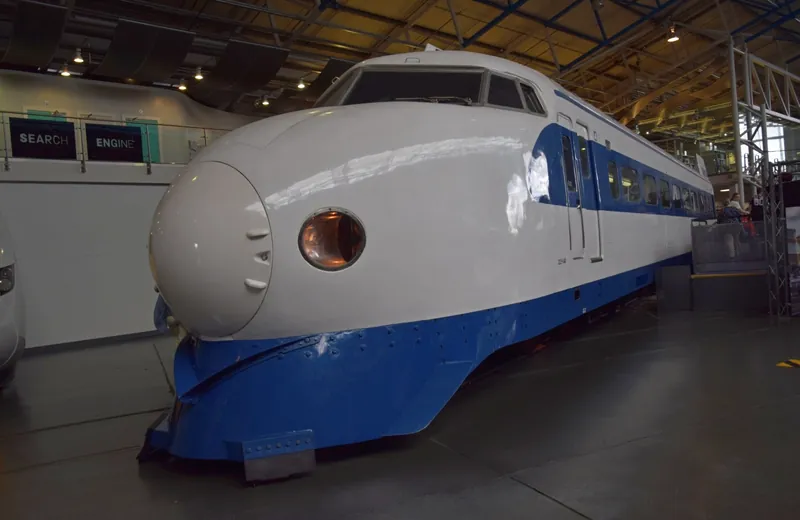
The National Railway Museum in York has Series 0 power car 22-141, built in 1976 and withdrawn in October 2000. Science Museum Group
22-141 was the last car of the first series to be withdrawn from service. Science Museum Group
When new it ran between Tokyo and Osaka in a 16-car train; from 1997 it ran between Hiroshima and Hakata in a four-car train. Science Museum Group
The power car is about 25 metres long (82ft) and 3.6 metres wide. Science Museum Group
JR West donated it to the National Collection, and more than 100 JR West workers restored it before it came to the UK. Science Museum Group
Professor Roderick Smith of Imperial College London helped arrange the gift of a Series 0 to the museum. Embassy of Japan
It was the first rail vehicle built and run outside Britain to join Britain’s National Collection. Science Museum Group
Is it the only one outside Japan? Sources differ
- The Science Museum Group’s catalogue calls it the only bullet train outside Japan. Science Museum Group
- The National Railway Museum’s own page calls it one of only two bullet trains outside Japan. NRM
Both come from the same museum group. The catalogue entry says “the only”; the museum’s visitor page says “one of only two”. We give both.
Its passenger carriage is open to visitors, with a ramp for step-free access. NRM
The same museum looks after Flying Scotsman, whose story is on flying-scotsman.railways.im.
Next: the lines →