Faster, quieter, smoother
From 210 km/h in 1964 to 320 km/h today, and a lesson from a kingfisher.
How this site works. Every fact is in our own words and linked to its source, beside it. Where good sources disagree, we show each version in a “Sources differ” box.
Top speeds
Britannica says trains first ran at up to 210km/h (130mph), and later improvements allowed 240 to 300km/h. Britannica
In October 2003 Shinagawa station opened and every Tokaido Shinkansen train’s top speed was raised to 270km/h. JR Central history
The top speed was raised to 285km/h on 14 March 2015. JR Central history
In early 2013 some trains began running at up to 320km/h (200mph). Britannica
JR East’s Series E5 began regular running at 320km/h on the Tohoku Shinkansen on 16 March 2013, the fastest speed then allowed for passenger trains in Japan. Railway Gazette, 2013
Journey times
At first the journey from Tokyo to Osaka took 4 hours, instead of 6 hours 30 minutes on an ordinary express. Embassy of Japan
With the Nozomi, Tokyo to Osaka came down to a fastest time of 2 hours 30 minutes. JR Central, 2024
The Tokaido Shinkansen’s top speed today is 285km/h, and the fastest trains take 2 hours 21 minutes from Tokyo to Shin-Osaka. JR Central
The fastest trains go from Tokyo to Hakata in about five hours, and from Tokyo to Aomori in about three. Britannica
Lessons from birds
Engineer Eiji Nakatsu says the bigger challenge was not speed but noise: the faster a train runs, the louder it gets. JFS, 2005
Owls fly almost silently, and the saw-toothed edges of their feathers inspired a quieter pantograph, the arm that collects electricity from the wires. JFS, 2005
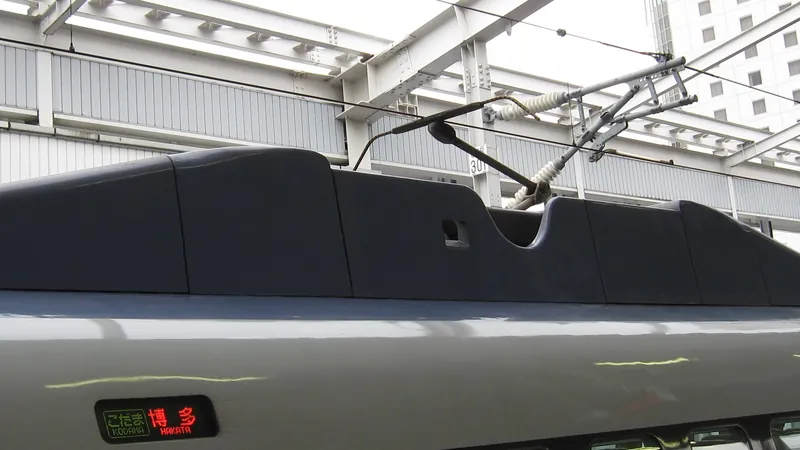
Trains rushing into tunnels made pressure waves that left the far end with a loud boom, heard by people 400 metres away. JFS, 2005
A kingfisher dives from air into water without a splash. Tests showed the best nose shape was almost the same as a kingfisher’s beak. JFS, 2005
The 500 Series nose is 15 metres long, and it cut air pressure by 30% and electricity use by 15%, while running 10% faster. JFS, 2005

Our view: the Shinkansen story is less about raw speed than about getting speed without noise, shaking or delay. The owl and the kingfisher solved problems a faster motor never could.
Next: every day →